
One question comes up again and again from DATV operators and anyone running a serious PA on QO-100: how much power can the IceConeFeed really take before the printed structure or the feedpoint starts to suffer?
Back in January 2021 one of our customers answered that the direct way — with a thermal-imaging camera and a deliberately harsh test.
The test
- Drive: 120 W CW — a continuous, unmodulated carrier. This is the worst-case thermal load a feed can see: 100 % duty cycle, full power, no let-up.
- Duration: ~5 minutes keyed continuously.
- Setup: feed driven directly, no dish. A reflector plays no role in how the feed itself heats, so it was left out to isolate the feed’s own thermal behaviour.
- Band: 2.4 GHz QO-100 uplink.
The thermal image
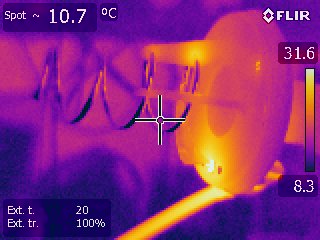
The scene is cold — most of the structure sits at ambient, around 8–10 °C on a winter day (the crosshair on the feed body reads 10.7 °C). There is exactly one hot spot: the driven feedpoint / matching region, glowing at the top of the palette.
| Reading | Value |
|---|---|
| Hottest point on the feed | 31.6 °C |
| Feed body (spot marker) | 10.7 °C |
| Ambient / coldest structure | ~8 °C |
| Temperature rise at hot spot | ≈ 20–22 K |
What it means
Under 120 W of continuous carrier — a load far harsher than any real on-air mode — the hottest point on the feed reached only about 31.6 °C, barely above body temperature, a rise of roughly 20 K above the cold ambient. The rest of the assembly hardly warmed at all.
Put that against the material: PETG softens (glass transition) around 75–80 °C, and the PTFE, coax and SMA hardware are rated far higher still. At the worst-case drive level the feed reaches well under half the temperature where the printed PETG even begins to soften.
And because CW is the harshest case, everything gentler is covered. DATV — even at high duty cycle — delivers a lower average power than a full continuous carrier, so a DATV station running 100 W sits comfortably inside this envelope.
Applies to the v2.1 as well
Although this test was run on the IceConeFeed v2, the result carries straight over to the v2.1. The v2.1 uses the identical connector and the same matching elements — only the radiating element is thinner. The feedpoint and matching section, which is exactly where the heat appears, are unchanged, so the thermal behaviour is the same.
Want one? The IceConeFeed v2 and v2.1 are in the shop, assembled and tuned for QO-100.