
The L-Band helix family covers the most important L-Band satellite and radio astronomy bands — all built on the same design. Each variant is optimized for a specific center frequency, polarization, and use case. All helixes ship fully assembled and tuned from the shop.
📺 Seen on TechMindsYT. Matt at @TechMindsYT reviewed our 10-turn L-Band helix and tested it on Inmarsat with a Sawbird filter+LNA — watch the review.
The L-Band Helix Family
📡 GPS L2/L5
1176 / 1227 MHz · RHCP · 10 turns
For precision positioning research, RTK experiments, and GNSS signal monitoring. Covers both GPS L2 and L5 with the correct RHCP polarization for GPS satellites.
-
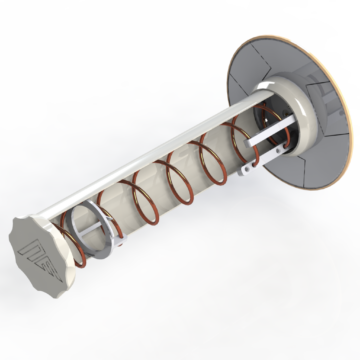
L-Band GPS L2/L5 1200 MHz
194,03 € – 209,04 €zzgl. Versandkosten
Lieferzeit / Delivery time: 3–12 Werktage / working days
Select options This product has multiple variants. The options may be chosen on the product page

🔭 Hydrogen Line
1420 MHz · RHCP · 7 or 10 turns
Tuned to the 21 cm hydrogen line for amateur radio astronomy. Higher-gain 10-turn option available for more directionality when scanning the galactic plane.
-
L-Band H1 1420 MHz
121,57 € – 151,20 €zzgl. Versandkosten
Lieferzeit / Delivery time: 3–12 Werktage / working days
Select options This product has multiple variants. The options may be chosen on the product page
🛰️ Satellite L-Band
~1550 MHz · RHCP or LHCP · 3 or 10 turns
General-purpose satellite reception — Inmarsat, Iridium, LEO birds and other L-Band downlinks. 3-turn version for use as a dish feed (dish reflection inverts polarization — select opposite hand to your target signal); 10-turn for direct pole or rotor mounting. Available in both polarizations.
-
L-Band Inmarsat 1525 MHz
114,38 € – 156,20 €zzgl. Versandkosten
Lieferzeit / Delivery time: 3–12 Werktage / working days
Select options This product has multiple variants. The options may be chosen on the product page
🌦️ WX HRPT
1700 MHz · RHCP · 3 turns
Designed for direct reception of NOAA and Metop HRPT weather satellite imagery. Compact 3-turn design works well as a dish feed or standalone for polar-orbiting weather satellites.
-
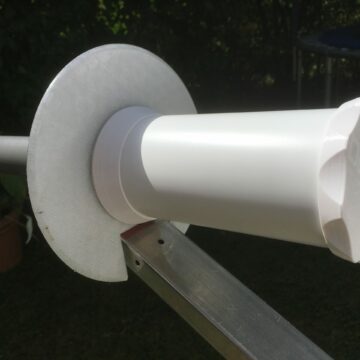
L-Band WX HRPT 1700 MHz
114,38 € – 136,56 €zzgl. Versandkosten
Lieferzeit / Delivery time: 3–12 Werktage / working days
Select options This product has multiple variants. The options may be chosen on the product page

Complete Setup: L-Band Bundle
The L-Band Bundle includes an antenna of your choice plus all mounting hardware for a complete receiver station — mast clamp, pole adapter, and all required fasteners.
-
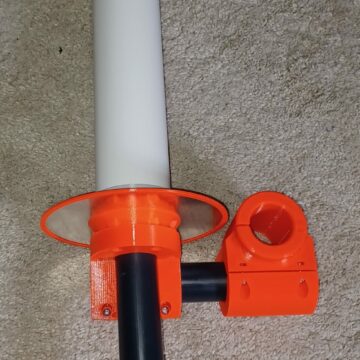
L-Band Inmarsat Bundle 1525 MHz (10-turn + accessories)
184,94 € (ohne MWSt. 155,41 €)zzgl. Versandkosten
Lieferzeit / Delivery time: 3–12 Werktage / working days
Add to cart

Mounting Options

🍽️ Dish Feed
The 3-turn variant mounts as a prime-focus feed for standard offset dishes, combining helix gain with dish gain. Important: a dish reflector inverts circular polarization — an RHCP helix receives LHCP-polarized signals off the dish, and vice versa. Select the helix hand opposite to your target signal polarization.

🗼 Mast / Pole
Mount on any standard antenna mast, push-up pole, or pipe clamp bracket using the 6× M4 bolt pattern on the backplate. The most common setup for geostationary targets (Inmarsat, Iridium) where no tracking is needed. The L-Band Bundle includes everything required for a complete mast installation.

🔄 Alt-Az Mount
For targets that move across the sky — hydrogen line galactic observations, LEO satellite passes, GPS L2/L5 research. Mounts on an az-el rotator, camera tripod with pan-tilt head, or any telescope alt-az mount using the same M4 bolt pattern.
Technical Drawing
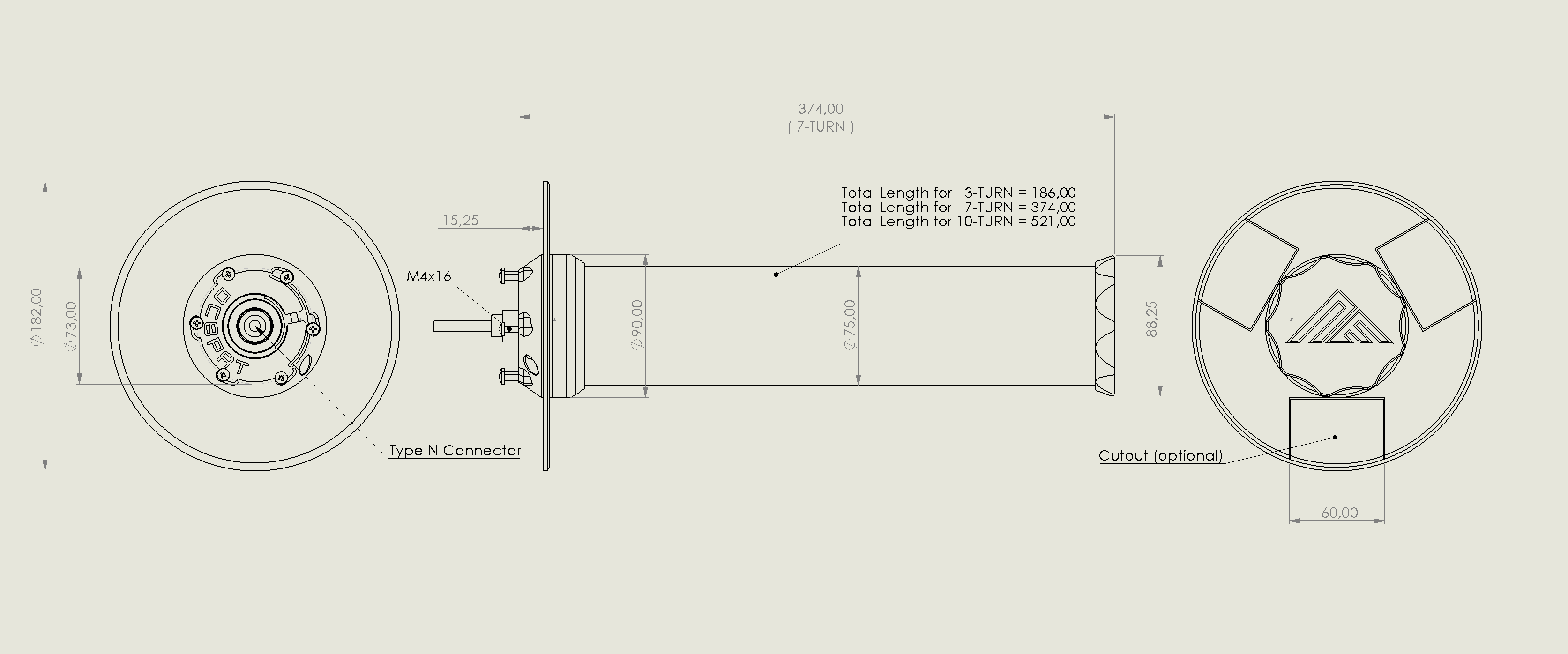
Dimensions shown for the RHCP 10-turn variant (521 mm length). RHCP 7-turn: 374 mm. LHCP 3-turn: 186 mm. All variants: 180 mm diameter. Click to enlarge.
Specifications at a Glance
| Specification | GPS L2/L5 | H1 1420 MHz | Satellite L-Band | WX HRPT |
|---|---|---|---|---|
| Center frequency | 1176 / 1227 MHz | 1420 MHz | ~1550 MHz | 1700 MHz |
| Bandwidth (SWR < 2) | > 200 MHz | > 200 MHz | > 200 MHz | > 200 MHz |
| Polarization | RHCP | RHCP | RHCP or LHCP | RHCP |
| Turns | 10 | 7 or 10 | 3 or 10 | 3 |
| Typical use | GPS L2/L5 positioning research | Hydrogen line, radio astronomy | Inmarsat, Iridium, LEO satellites | NOAA / Metop HRPT weather imagery |
| Connector | Type N | Type N | Type N | Type N |
| Material | PETG, UV-resistant | PETG, UV-resistant | PETG, UV-resistant | PETG, UV-resistant |
3D Radiation Pattern
Full-sphere gain pattern measured at the Antenna Test Facility. Use the frequency slider to step through measured frequencies. Drag to rotate, scroll to zoom.
2D Radiation Pattern
Polar cuts at key frequencies. Use the frequency slider to step through measured frequencies. About the Antenna Test Facility →
From the Lab

L-Band Helix for Radio Astronomy
A practical guide to hydrogen line detection with the H1 1420 MHz antenna — setup, LNA selection, and first results.
L-Band Antenna Updates
Iterative improvements to the helix design — mounting hardware, connector options, and frequency variant additions.

L-Band WebSDR
Live L-Band WebSDR receiving Inmarsat and other satellites in real time — accessible from any browser.