Scope
The Quantum Entropy Source (QES) project explores the generation, measurement, and dissemination of high-quality physical entropy derived from fundamentally unpredictable physical processes.
At its core, the project focuses on quantifiable entropy, not merely random-looking numbers. The system continuously measures physical events, estimates entropy in real time, applies cryptographically sound conditioning, and exposes both entropy products and health metrics transparently via live dashboards and APIs.
The long-term goal is to provide a reliable, auditable, and openly observable entropy source suitable for research, experimentation, and integration into distributed systems.
Theory (High-Level)
In this project, entropy is used in the information-theoretic and cryptographic sense:
Entropy is a quantitative measure of the unpredictability of a physical process.
The system derives entropy from the timing uncertainty of radioactive decay events, a process governed by quantum mechanics and widely accepted as fundamentally unpredictable.
Cryptographic conditioning (e.g. SHA-256) is used to produce uniform output without increasing entropy
- Entropy resides in the physical process, not in the output bits
- Output bitstreams carry entropy only if extraction is done correctly
- Entropy is quantified conservatively using min-entropy bounds
System Overview
Physical Entropy Source
- Naturally occurring radioactive material embedded in ceramic matrix
- Decay events detected using Geiger-Müller tubes
- High-resolution hardware timers capture event timestamps
- Timing jitter and arrival statistics form the raw entropy source
The radioactive material is fixed, non-dispersible, and continuously monitored. External radiation exposure remains comparable to natural background levels.
Entropy Processing Pipeline
- Event detection (decay triggers)
- High-resolution timestamp capture
- Raw entropy estimation
- Health monitoring and interference detection
- Cryptographic conditioning
- Distribution and visualization
Entropy rate and quality metrics are continuously computed and logged.
Operational Safety & Transparency
Operational safety is treated as a first-class design requirement.
- Radiation levels are continuously monitored
- Alpha radiation remains fully contained within the material matrix
- Dose rates remain well below public exposure limits
- The radioactive material is not accessible during normal operation
Live radiation and entropy health data are publicly visible via the dashboard.
Development Roadmap
V1 Prototype
The V1 system demonstrates end-to-end entropy generation, monitoring, and dissemination.
- Utilization of quantum randomness via radioactive decay
- Single Geiger-Müller counter
- Entropy rate >= 200bit/s
- Basic health monitoring
- Real time data dissemination
- Public dashboard access
V1 Architecture
The architecture separates physical sensing, entropy estimation, conditioning, storage, and presentation into independent modules to allow verification and future scaling.
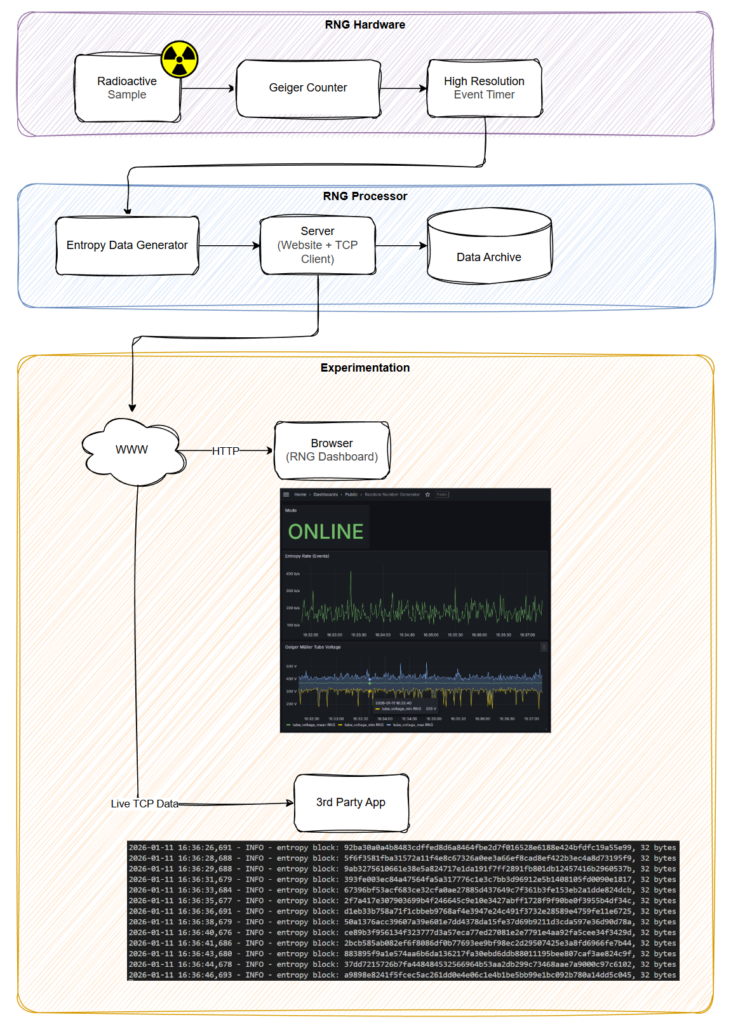
Live Dashboard
The live dashboard exposes the internal state of the system in real time, including:
- Event rates (counts per minute)
- Estimated entropy rate (bits per second)
- Conditioning throughput
- Health test status
- Long-term stability trends
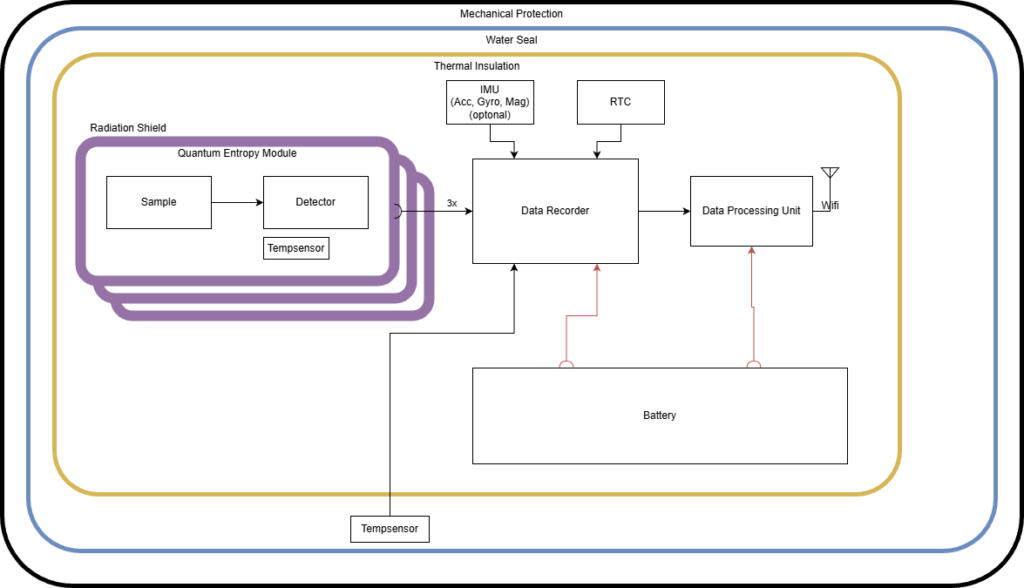
V2 Operational Unit — Field-Deployable System
V2 shall enable quantum effect studies, remotely or in field
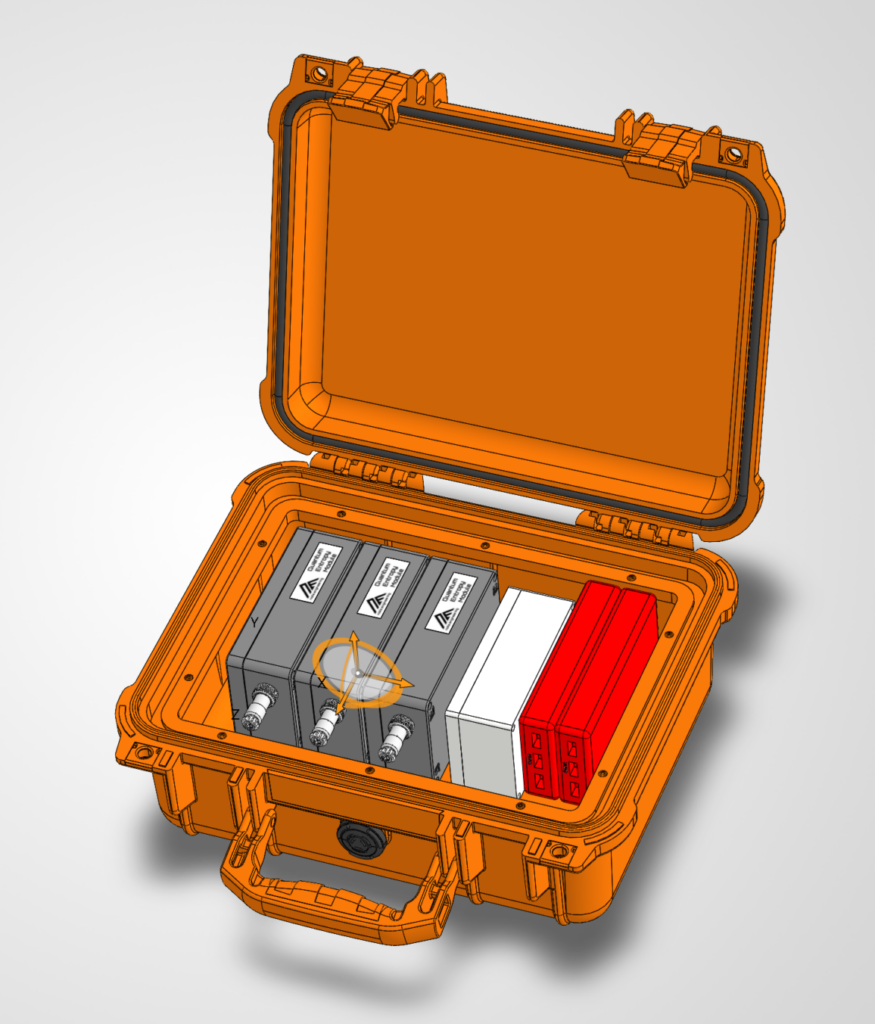
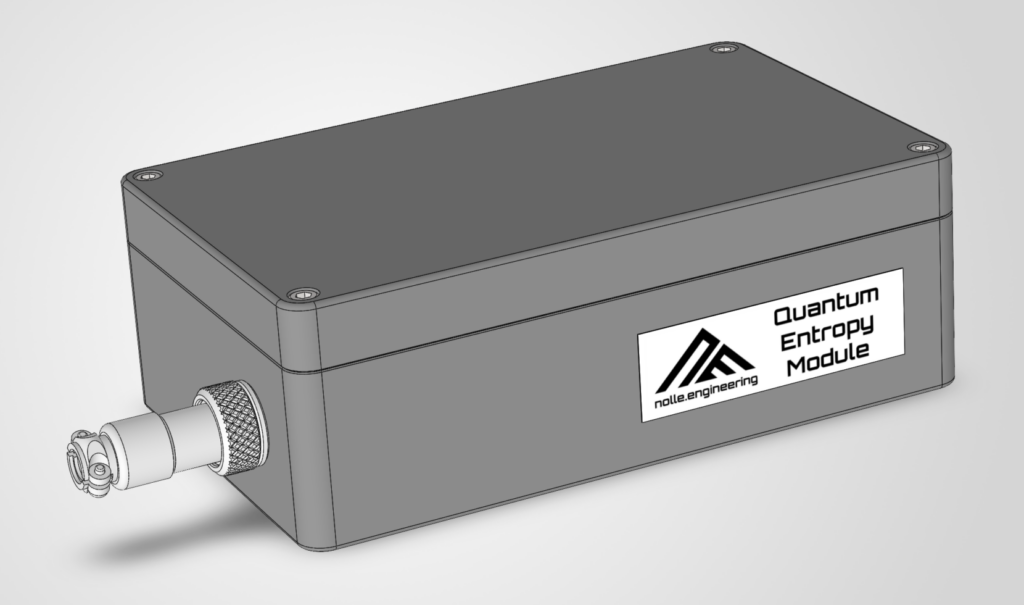
- 3 separate Quantum Entropy Modules
- Entropy rate >= 2kbit/s per module
- Radiation and thermal shielding
- Randomness Correlation Monitor
- Ruggadized, portable design
- battery runtime > 48h
V2 is designed for long-term unattended operation, data collection and external integration.
V2 Architecture