
We develop and test our antennas in Bavaria, where a hard winter is a few days below zero. So for the question of how the IceConeFeed handles a real Nordic winter, we asked the operators who run it there. Here is what they report.
A note on what the IceConeFeed is, since it matters here: it is a dual feed. A 2.4 GHz helix transmits the QO-100 uplink, while the 10 GHz X-band downlink passes through the feed to the unmodified LNB behind it — one unit for transmit and receive, no LNB modification. That is how the station below runs it.
Two years north of 60°N
The clearest data point is a Finnish operator (OH2JKU) who has run an IceConeFeed outdoors, year-round, north of 60°N for more than two years. His is also one of the rarer setups — an RHCP configuration using two reflectors (see IceConeFeed Right Hand Circular for why a dual-reflector dish needs the mirrored feed) — so it is working harder than a typical install.
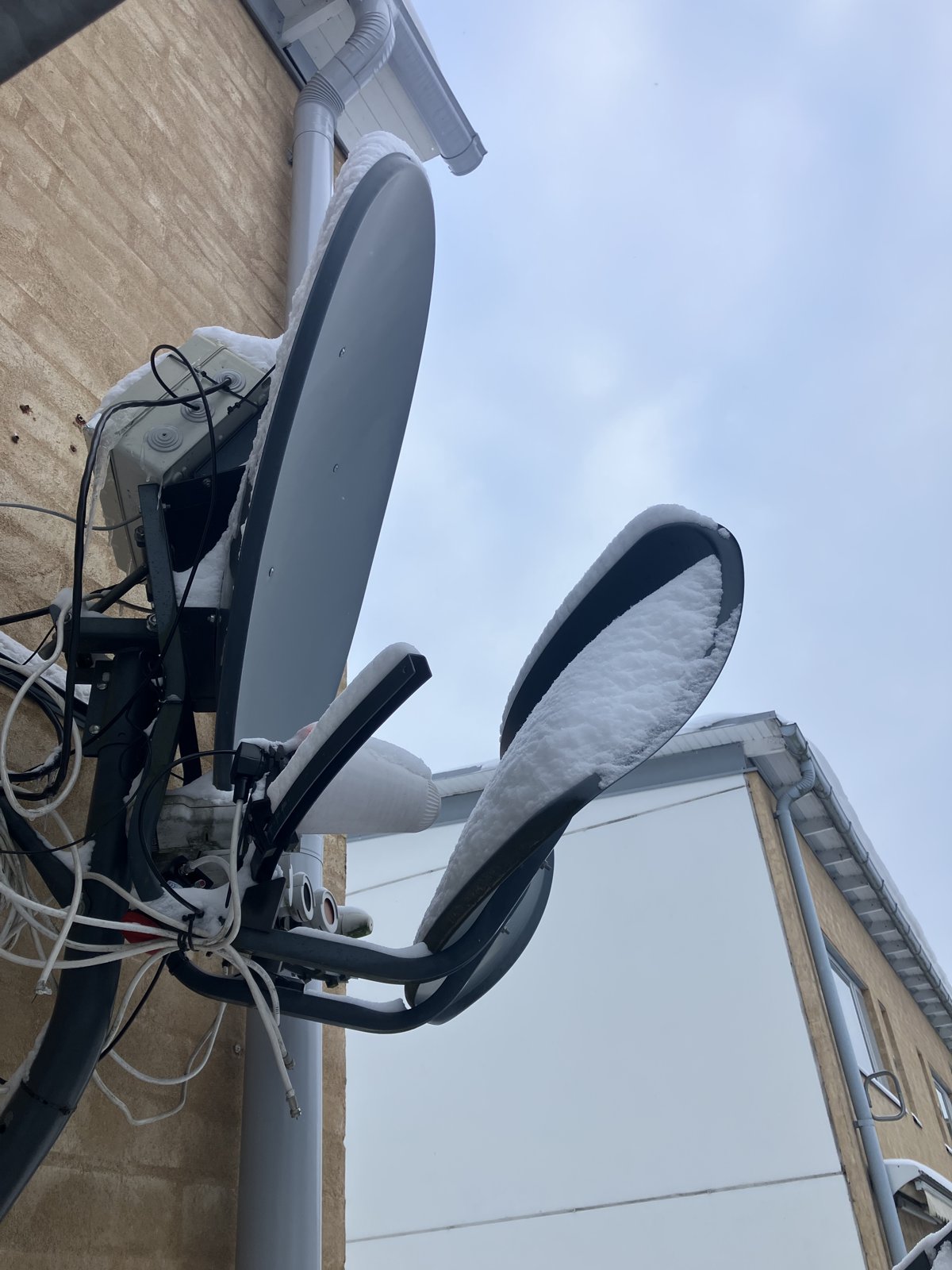
After more than two years of continuous outdoor use north of 60°N, the IceConeFeed has held up well. Compared with the other antennas at the same location, it collects very little snow.
OH2JKU, Finland
No extra weatherproofing was applied, and the connectors stayed clean over the whole period. The stock adapter rings covered several LNBs; for one odd size he added a turn of tape.
Frost inside the radome
The concern we hear most is ice forming inside the radome. A ham in eastern Finland asked exactly this: nights near −35 °C, a daily swing to 0 °C and back, and a friend whose (different) feed had iced up inside and had to be thawed indoors.
The mechanism matters. Frost inside a waterproof-but-not-hermetic enclosure is not water leaking in; it is the enclosure breathing — as it thermal-cycles it draws humid air in through small gaps, and the moisture freezes on the coldest inner surface. So the fix is to vent it, not seal it harder: one or two small drain holes at the lowest point let condensate out and the inside equalise. In the field, an operator near Kempele opened his after an LNB change at −20 °C and found only “very little” condensation inside. None of the operators we heard from reported frost inside as a real problem.
Snow, ice and signal
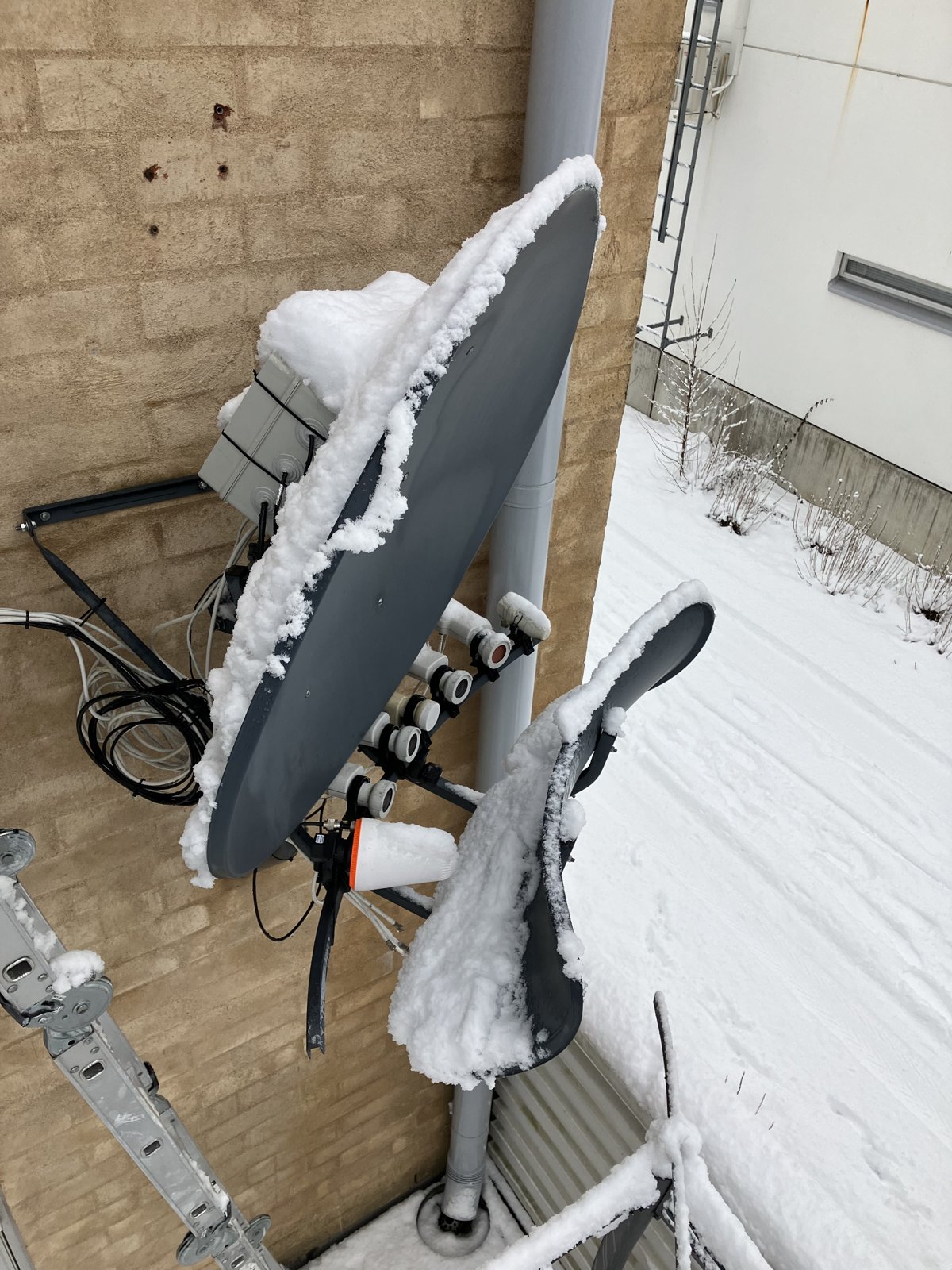
Below 0 °C, snow and hoarfrost caused no measurable signal loss — frost and light snow shed on their own, and the cone collects less than a flat feed. The one nuisance is wet snow just above 0 °C, which can sit on the dish and feed; but that affects any antenna, not just this one. Mount it within reach of a broom and it is a non-issue.
Plastic, sun and heating
The printed PETG came through several winters and summers of direct sun with no cracking and no visible UV damage; the operator’s own summary after two winters was “no signs of wear so far.” One handling note: do not open the radome when it is very cold, as the plastic is more brittle then — warm it first. None of the operators heat the feed, and none found it necessary; the cold shifts the receive frequency slightly, which you correct with RIT. (A dish heating-mat warms the reflector, not the feed.)
Extreme wind
On very exposed sites the feed can be blown off the LNB, since it pushes on by friction. One operator in Iceland — where exposed sites routinely see winter gusts around 200 km/h — reported exactly this. The fix is to glue the LNB into the feed (cyanoacrylate or two-component epoxy); the only trade-off is that you can no longer pull the LNB out, which on a fixed installation is no loss.
In short, across several Nordic sites down to −35 °C: minimal snow build-up, no meaningful signal loss, clean connectors without extra sealing, and no cracking or UV damage. Frost inside is a venting question; wet snow affects any feed; only extreme wind calls for a dab of glue.
See the IceConeFeed v2.1, and for choosing an LNB, the LNB adapter ring selection guide.